1000/1060 mm Coverage Hi-Rib Roofing Roll Forming Machine Guide for India
Technical evaluation and equipment planning guide for Indian PEB manufacturers, coil service centers, and roofing sheet roll formers across Maharashtra, Gujarat, Tamil Nadu, and NCR. Covers 5-rib and 6-rib Hi-Rib trapezoidal profiles (1000 mm to 1060 mm effective coverage from 1220 mm / 1250 mm coil), high-tensile PPGI/PPGL springback management, inline crimp-curve options, 415V 50Hz electrical matching, and sea freight to Nhava Sheva (JNPT) or Chennai.
ENGINEERING NOTICE
Equipment configurations, forming station sequences, drive motor power, and shear profiles are custom engineered to order. All operational parameters, profile tolerances, and delivery scopes are confirmed per signed project contract and configured to buyer drawing.
MARKET CONTEXT
Indian Market Focus: High-Coverage Hi-Rib PEB Sheeting
Examining the profile geometry, coil width standards, and accessory integration required by India high-volume pre-engineered building (PEB) and industrialshed sectors.
1000 mm to 1060 mm Effective Cover Widths
Indian roofing roll formers optimize sheet coverage from domestic 1220 mm and 1250 mm wide PPGI/PPGL coils, producing 28 mm to 32 mm deep 5-rib or 6-rib Hi-Rib sheets with 1000 mm to 1060 mm net effective coverage.
Anti-Capillary Groove & Return Leg Design
To withstand intense Indian monsoon downpours on wide-span factory roofs, Hi-Rib profiles incorporate dual anti-capillary flutes on the side-lap crest and a full return leg to support fastener seating.
High-Tensile Domestic Coil Grades
Indian coil producers supply both commercial mild steel (240–300 yield grade) and high-tensile structural Galvalume (550 yield grade). Roll pass sequences must be designed to control rib angle springback and valley pan flatness across both material classes.
MACHINE HIGHLIGHTS
Indian Hi-Rib Roll Forming Line: Mechanical & Process Engineering
Mechanical design criteria and process considerations evaluated for this profile geometry.
Progressive Rib & Valley Stiffener Roll Passes
Forming stations are sequenced to form center valley stiffeners (pencil ribs or V-grooves) and main trapezoidal ribs progressively, preventing width shrinkage error or edge wave on 1220 mm and 1250 mm coils.
Optional Crimp-Curving & Ridge Cap Coordination
Indian industrial sheds frequently utilize curved eave sheets (Crimp Curve) and matching ridge caps. We can evaluate standalone or auxiliary crimp-curving units matched to the exact Hi-Rib pitch configured to buyer drawing.
Heavy-Duty Shafts & Hard Chrome Rollers
Solid machined steel shafts and hard chrome plated rollers withstand continuous multi-shift operation on domestic PPGI and Galvalume coils without premature groove wear.
415V 50Hz Three-Phase Indian Grid Integration
Main drive motors, hydraulic stations, and PLC control cabinets are configured for India standard 415V 50Hz three-phase industrial supply.
SPECIFICATION CHECKLIST
Technical Checklist: Inputs Required for Indian Hi-Rib Line Quotation
To prepare a detailed engineering proposal for an Indian Hi-Rib roofing line, our technical team requires confirmation of the following parameters:
• Hi-Rib Section Drawing & Pitch DetailsConfigured to buyer drawing: confirmed CAD cross-section showing rib height (e.g., 28 mm or 30 mm), pitch (e.g., 200 mm or 250 mm), effective cover width (1000 mm or 1060 mm), and valley stiffener design.
• Input Coil Width (1220 mm vs. 1250 mm)Exact slit or mill-edge coil width supplied by your Indian steel mill (such as JSW, Tata, AM/NS, or imported stock).
• Confirmed Decimal Thickness RangeRequired thickness range in decimal millimeters (BMT and TCT, e.g., 0.35 mm to 0.80 mm) confirmed per signed project contract.
• Coil Yield Strength & Coating TypeWhether the line will primarily process high-tensile 550 grade PPGL/Galvalume, 240–350 grade PPGI, or both.
• Decoiler Capacity & Automation LevelSelection of 5-ton or 10-ton hydraulic decoiler with coil car, and manual runout tables versus automated sheet stacker.
Note: All tooling designs are confirmed via CAD section drawing prior to workshop production.
TECHNICAL BENCHMARK
Indian Hi-Rib Line: Engineering Variables & Review Baseline
Engineering variables and baseline configuration parameters evaluated against customer drawings.
Indian Hi-Rib Line: Engineering Variables & Review Baseline
System Element
Parameter / Specification Baseline
Engineering Review Criterion
Forming Station Count
Confirmed per signed project contract and Hi-Rib geometry
Configured to buyer drawing to maintain accurate 1000/1060 mm cover width on high-tensile coils.
Roller Tooling Material
CNC-machined steel with hard chrome surface plating
Protects prepainted polyester and Galvalume coatings during multi-shift industrial runs.
Main Shafts & Stand Housings
Solid precision-ground steel shafts in rigid stands
Engineered to resist bending deflection when forming 0.50 mm to 0.80 mm structural sheets.
Hydraulic Cutoff Shear
Contoured post-cut hydraulic shear configured to buyer drawing
Profiled blades match main ribs and valley stiffeners for clean, burr-free sheet ends.
Electrical & PLC Control System
415V 50Hz 3-phase motor package with touch-screen PLC
Digital encoder length control, batch programming, and multi-stage safety interlocks.
WORKSHOP VIEWS / PROJECT DISCUSSION
Look at the details. Define your requirements.
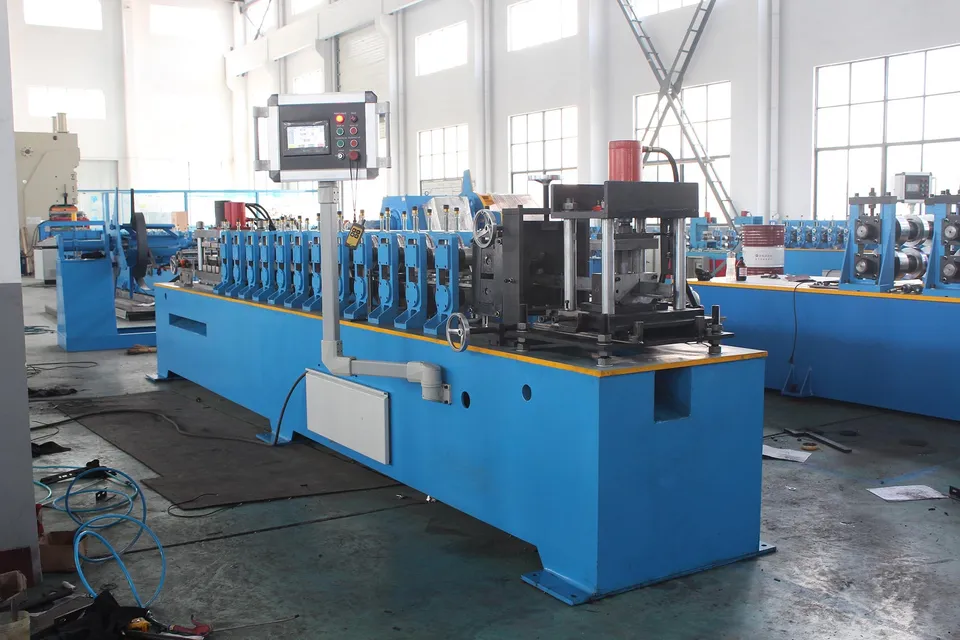
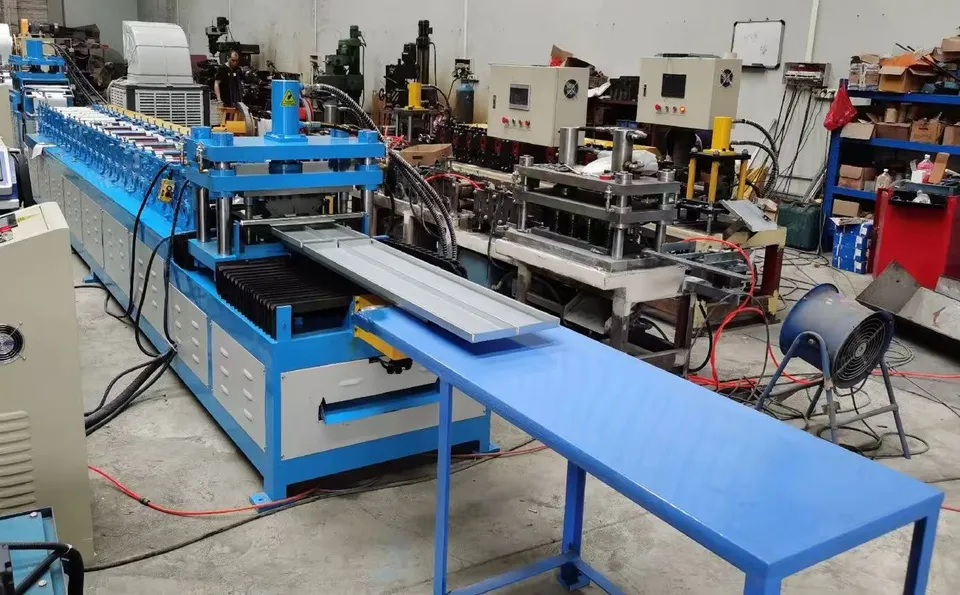
Workshop-zone views of multi-station roll forming lines and profile cutoff assemblies. Captions describe visible mechanical arrangements. They do not certify specific output or individual plant performance.
01Line layout and controls02Outfeed and sample handling
TECHNICAL FAQ
Frequently Asked Questions: Indian Hi-Rib Roofing Machinery
Technical clarifications on tooling design inputs, operating limits, and production feasibility.
How is 1060 mm effective cover width achieved compared to 1000 mm cover width?
Effective coverage depends directly on the input coil width (1220 mm vs. 1250 mm), the rib height (e.g., 28 mm vs. 30 mm), and the number of ribs (5-rib vs. 6-rib). Our engineers verify the exact strip consumption calculation against your CAD profile drawing before machining the rollers.
Can a crimp-curving unit be supplied to match the Hi-Rib profile?
Yes. Because crimp-curving dies must match the exact rib pitch, crest width, and rib height of the formed sheet, ordering the crimp-curving unit alongside the roll forming line ensures geometric compatibility.
How does the machine handle high-tensile 550 grade Galvalume coils?
Forming high-tensile coil requires sufficient forming passes and rigid shaft diameters so the rib angles are progressively over-bent to compensate for elastic springback, keeping the final sheet flat and accurate to width.
What are the container shipping routes to Indian ports?
Machinery is packed and braced in standard ocean containers and shipped from Tianjin Port to Nhava Sheva (JNPT Mumbai), Mundra Port, Chennai Port, or Kolkata/Haldia depending on your plant location.
START ENGINEERING REVIEW
Plan Your Indian Hi-Rib or PEB Roll Forming Line with Taibang
Share your 1000 mm or 1060 mm Hi-Rib CAD drawing, input coil width, and target thickness range. Our engineering team will review strip width calculations and prepare a technical quotation.