IBR Profile (Inverted Box Rib) Roll Forming Machine Guide for Kenya
Technical evaluation and equipment planning guide for Kenyan sheet producers manufacturing the classic IBR deep-rib trapezoidal profile. Outlines profile verification against customer CAD drawings, coil thickness tolerances, electrical matching for Kenyan industrial power, and containerized dispatch from Cangzhou to Mombasa.
ENGINEERING NOTICE
Equipment configurations, forming station sequences, drive motor power, and shear profiles are custom engineered to order. All operational parameters, profile tolerances, and delivery scopes are confirmed per signed project contract and agreed engineering drawings.
Examining typical application areas and engineering considerations for IBR profiles specified in Kenyan commercial warehousing and industrial construction.
Deep-Rib Section Modulus
The traditional IBR profile features angular trapezoidal ribs designed to provide high bending stiffness across broad roof pitches. The deep profile geometry demands careful roll forming progression to avoid excessive thinning at rib crests.
Water Evacuation Drainage Channels
Broad drainage valleys between main ribs assist in channeling rainwater runoff on long roof slopes. Tooling design must accurately maintain side-lap nesting to prevent water infiltration at sheet overlaps under regional weather conditions.
Valley Pan Stiffening Flutes
Valley pans frequently incorporate small stiffener flutes to reduce visual oil-canning across wide flat areas. Tooling design must coordinate the formation of these center flutes alongside primary rib bending steps.
MACHINE HIGHLIGHTS
IBR Roll Forming Machine: Tooling & Mechanical Considerations
Mechanical design criteria and process considerations evaluated for this profile geometry.
Progressive Forming Sequence
Forming deep trapezoidal ribs requires a calculated station progression that distributes metal strain gradually from center ribs outward, minimizing longitudinal edge wave and camber across the formed strip.
Tooling Surface Treatment
Rollers are CNC machined and surface finished to protect prepainted polyester and aluminum-zinc alloy coatings commonly used in the East African market against scuffing during high-pressure forming passes.
Profile-Contoured Hydraulic Cutoff
The cutoff shear incorporates profiled blades matching the agreed IBR cross section. Blade geometry is verified against customer drawings to deliver clean end cuts without deforming rib crests.
Industrial Electrical Configuration
Drive motors, control cabinets, and hydraulic power units are configured to match local factory three-phase electrical supply, accompanied by standard overload protection and digital length control consoles.
SPECIFICATION CHECKLIST
Technical Checklist: Inputs Required for IBR Tooling Review
Before finalizing equipment dimensions and roll tooling schematics, our engineering team requires confirmation of the following technical points:
• Section Drawing & Lap DetailsConfirmed CAD cross-section showing net effective cover width, rib height, rib pitch, side lap overlap details, and intermediate flute dimensions.
• Feed Coil Dimensions & ToleranceInput slit coil strip width and confirmed decimal thickness range in millimeters (BMT and TCT) rather than approximate trade gauge designations.
• Substrate & Yield StrengthCoil material type (PPGI, PPGL, Aluzinc, or galvanized) and specified yield strength (e.g. G300 or G550) to evaluate springback compensation.
• Plant Power SupplyExact factory electrical supply specification (voltage and frequency) to correctly wind drive motors and calibrate hydraulic power units.
• Outfeed & Staging RequirementsRequired cut length range and selection of finished sheet support systems (manual runout racks or automated stackers).
Note: All tooling designs are confirmed via CAD section drawing prior to workshop production.
TECHNICAL BENCHMARK
IBR Roll Forming Line: Engineering Variables & Review Baseline
Engineering variables and baseline configuration parameters evaluated against customer drawings.
IBR Roll Forming Line: Engineering Variables & Review Baseline
System Element
Parameter / Specification Baseline
Engineering Review Criterion
Forming Station Count
Determined by rib height and metal strain simulation
Station count is calculated per CAD drawing to maintain smooth metal flow across forming passes.
Tooling Material & Finish
Machined carbon steel with protective surface plating
Roller surface hardness and finish selected to prevent marking on coated coil stock.
Main Shaft Construction
Solid forged steel shafts, precision turned and ground
Shaft diameter sized to resist torsional and bending deflection under continuous load.
Profile Cutoff Assembly
Hydraulic post-cut die profiled to IBR contour
Upper and lower shear blades match the specific sheet cross section to ensure clean cut ends.
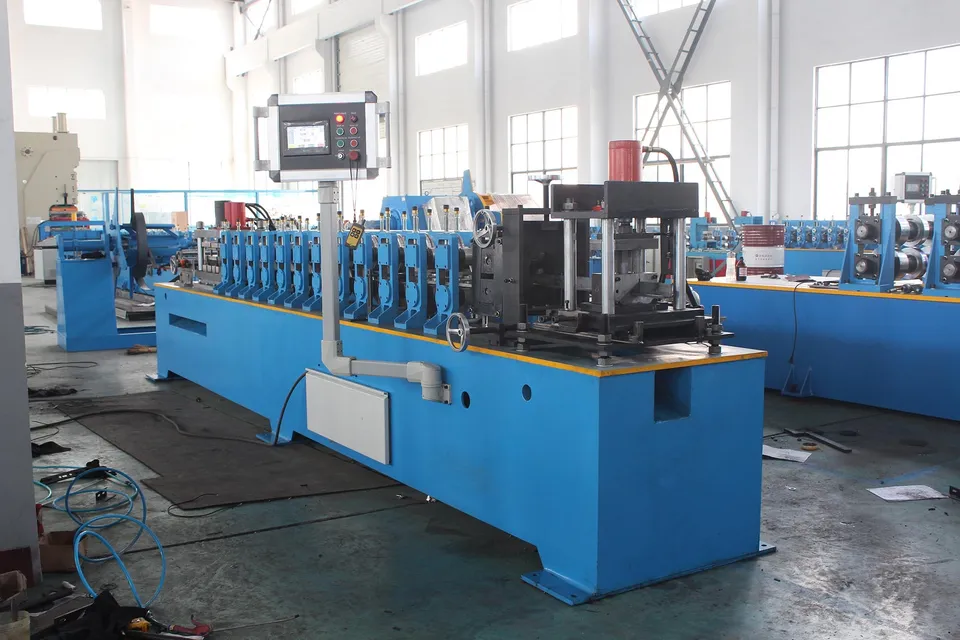
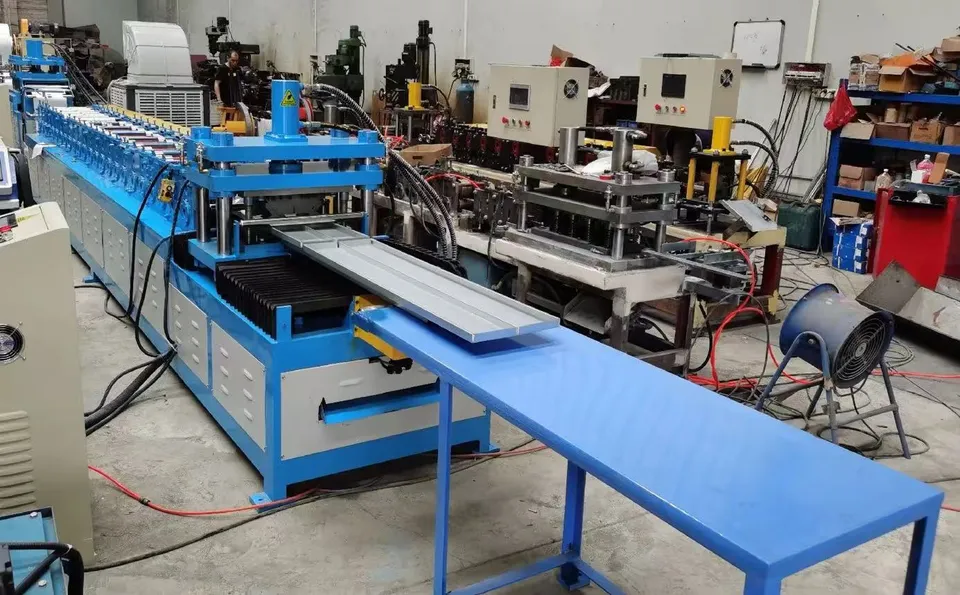
Workshop-zone views of multi-station roll forming lines and profile cutoff assemblies. Captions describe visible mechanical arrangements. They do not certify specific output or individual plant performance.
01Line layout and controls02Outfeed and sample handling
Technical clarifications on tooling design inputs, operating limits, and production feasibility.
What is the primary difference in application between IBR and Box Profile?
IBR typically features a deeper trapezoidal rib geometry aimed at heavy commercial and warehousing structures requiring substantial beam stiffness. Box Profile offers wider effective coverage from standard coils, prioritizing square-meter coverage efficiency for residential and light commercial roofing. Each requires dedicated roll tooling.
Can one machine produce both IBR and Box Profile?
Because the rib depths, angles, and station progressions differ substantially, they cannot be formed by the same set of roll stands. A double-deck chassis can be engineered where one deck forms IBR and the other forms Box Profile or corrugated sheets, sharing a common frame and electrical console.
Why must coil thickness be specified in millimeters instead of trade gauges?
Trade gauge numbers (such as G28 or G30) often vary between steel suppliers. Precise tooling clearances must be ground to confirmed decimal millimeter thickness ranges to avoid surface scratching on thick stock or improper rib definition on thin stock.
How is maritime transport arranged for Kenya?
Machinery is dismantled into modular assemblies, protected against ocean moisture, and secured inside standard dry shipping containers for transit from Tianjin Port to the Port of Mombasa, suitable for on-forwarding via road or rail.
START ENGINEERING REVIEW
Initiate Technical Review for Your IBR Profile Project
Provide your profile CAD cross-section, target coil specifications, and plant electrical requirements. Our engineering desk will review tooling feasibility and prepare an equipment proposal.