Cold roll forming equipment engineered for the Kenyan metal roofing market.
Technical planning for Kenyan roofing manufacturers and sheet profiling workshops across Nairobi, Mombasa Road, Athi River, and Ruiru. Compare box profile, sinusoidal corrugated, and glazed step tile lines with 415V 50Hz electrical matching and ocean freight routing from Cangzhou to Mombasa.
ENGINEERING NOTICE
Equipment configurations, tooling pass counts, drive ratings, and coil width capacities are engineered to order. All production parameters are confirmed per signed project contract and agreed profile drawings.
MARKET OVERVIEW
Kenyan roofing production and operating context
Aligning machinery design with local commercial building practices, coil supply routes, and workshop conditions.
Industrial hubs & decentralized profiling
Metal roofing production in Kenya centers on major manufacturing clusters along Mombasa Road, Athi River, and Ruiru, alongside expanding regional operations in Nakuru, Kisumu, and Eldoret. Local sheet profiling operations increasingly invest in dedicated forming lines to provide quick cut-to-length service, reducing intermediate warehousing and site transit damage on finished sheets.
Coil stock & protective coatings
Kenyan roll formers process imported and regionally coated coils, including prepainted galvanized iron (PPGI) and aluminum-zinc alloy coated steel (PPGL / Aluzinc). In coastal zones near Mombasa, aluminum-zinc alloy coatings are preferred for atmospheric corrosion resistance, while inland markets utilize both standard galvanized and prepainted coil stock in popular regional finishes such as tile red, charcoal, dark green, and brilliant blue.
Gauge specifications vs. decimal thickness
In the Kenyan commercial metal roofing trade, sheet materials are commonly referred to by trade gauge designations such as G28, G30, and G32. Because commercial gauge conventions can vary between coil producers, roll tooling and cutoff shear blades must be engineered to verified decimal millimeter dimensions. Defining both Base Metal Thickness (BMT) and Total Coated Thickness (TCT) prevents premature tooling wear and surface coating scuffing.
PROFILE GEOMETRIES
Common profiles for Kenyan construction
Tooling design, station counts, and cutoff dies matched to regional architectural and agricultural sheet profiles.
Box profiles, also referred to as Inverted Box Rib (IBR) or IT5 sections, are the dominant choice for modern commercial warehouses, retail developments, agricultural packing sheds, and contemporary residential roofs across Kenya.
Structural stiffness: Angular trapezoidal ribs provide a high section modulus, allowing wider purlin spacing and reduced structural steel weight.
Weather performance: Deep drainage pans and anti-capillary side laps ensure water discharge during severe East African tropical downpours.
Tooling requirements: Progressive roll stands form the profile gradually outward from center ribs to minimize edge stretching and pan oil-canning.
The traditional continuous wave sinusoidal profile remains a high-volume staple in rural residential construction, agricultural outbuildings, perimeter hoarding, and regional building supply retail.
Framing adaptability: Continuous gentle arcs provide uniform transverse flexibility, accommodating natural settling in rough-sawn timber purlins.
High-volume processing: Symmetrical wave geometries require steady forming progression, simplifying roll maintenance and clearance adjustments.
Coil compatibility: Accommodates lighter commercial gauge coils with consistent pitch control across the full sheet width.
Stepped tile profiles simulate classic clay and slate roofing aesthetics for residential villas, modern housing estates, institutional buildings, and hospitality resorts across Kenya.
Two-stage production: Longitudinal wave roll forming passes are followed by an integrated hydraulic step-pressing mold that stamps transverse tile drops.
Die contour cutting: 3D profile-matching shear blades produce clean transverse end cuts synchronized with the stepped pattern.
Finished product value: Architectural stepped sheets command higher market margins per linear meter compared to basic industrial sheets.
Double-deck machine configuration for multi-profile flexibility
For workshop facilities with limited floor area or businesses entering the market, a double-deck roll forming machine incorporates two distinct profile sets within a single frame — such as an upper deck for box profiles and a lower deck for sinusoidal corrugated sheets. Both decks share a common main drive motor, hydraulic power station, and touchscreen PLC console. Production alternates between decks, providing two saleable product families from one equipment investment.
WORKSHOP VIEWS / PROJECT DISCUSSION
Look at the details. Define your requirements.
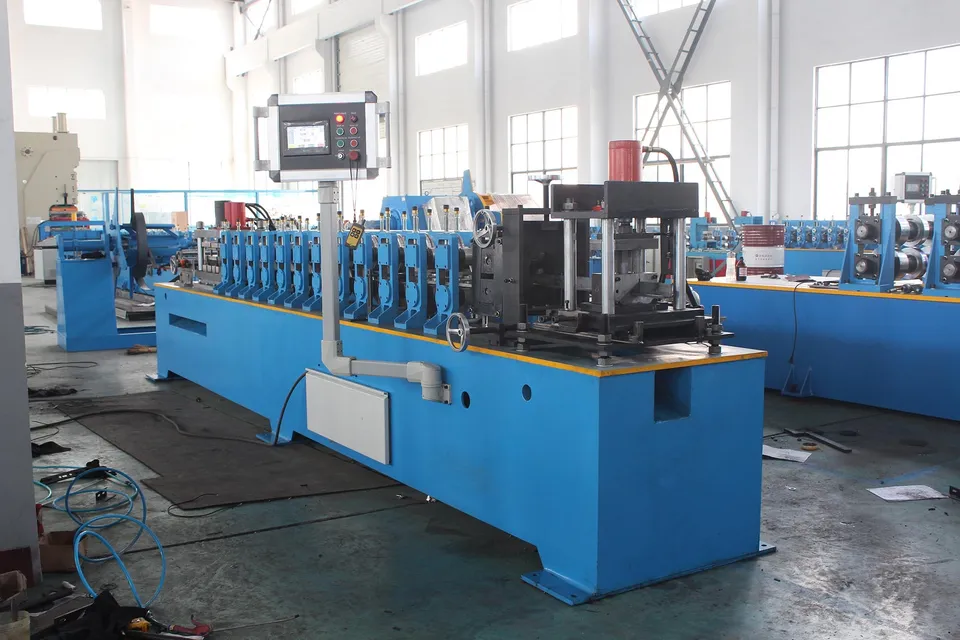
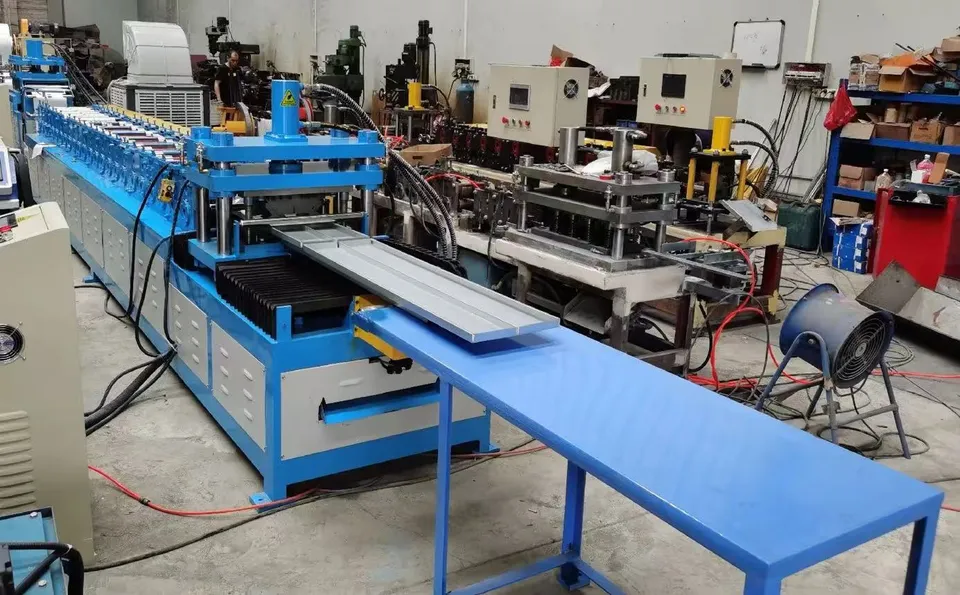
Workshop-zone views of multi-station roll forming lines and profile cutoff assemblies. Captions describe visible mechanical arrangements. They do not certify specific output or individual plant performance.
01Line layout and controls02Outfeed and sample handling
ELECTRICAL ENGINEERING
Electrical considerations for Kenyan installations (415V 50Hz)
Matching drive motors, control enclosures, and power protection to local industrial grid conditions.
Electrical engineering parameters and site preparation for Kenyan facilities
System Element
Kenyan Site Requirement
Taibang Engineering Provision
Supply Voltage & Frequency
Nominal 415V 3-phase, 50Hz industrial grid supply (240V single phase).
Main drive motors and hydraulic power packs are wound and rated specifically for 415V 50Hz 3-phase operation.
Motor Attestation
Compliance verification for industrial machinery drive components.
Electric drive motors carry verified CE attestation (Certificate M.2023.206.C82549, UDEM International) covering the EU Machinery Directive 2006/42/EC and EMC Directive 2014/30/EU.
Voltage Stability & Protection
Grid sags, surges, and supply instability common in outlying industrial areas.
Integration of variable frequency drives (VFD) for controlled motor acceleration, surge protective devices in the main panel, and guidance on upstream automatic voltage regulators (AVR).
Generator Integration
Frequent use of standby diesel generation during public grid interruptions.
Control panels engineered with stable low-voltage DC control supplies to buffer PLC and encoder circuits against generator frequency variations.
Operator Interface
English-language operation across factory supervisory and shop-floor teams.
Dual-language touchscreen HMI (English / Chinese) with intuitive parameter inputs for sheet lengths, batch quantities, and manual jogging controls.
LOGISTICS & SUPPORT
Why Taibang for Kenyan roll forming projects
Direct ocean logistics from Northern China to East Africa paired with technical review grounded in practical manufacturing.
Direct ocean freight: Cangzhou to Mombasa
Our manufacturing facility in Cangzhou, Hebei, is positioned close to Tianjin and Qingdao container ports. Containerized shipments move along established direct maritime routes to the Port of Mombasa, the primary maritime gateway for Kenya and East Africa. Cargo can be cleared directly at Mombasa or transferred under bond via the Standard Gauge Railway (SGR) to the Nairobi Inland Container Depot (ICD) at Embakasi.
Marine export packaging standards
To withstand humidity and maritime transit across the Indian Ocean, bare tooling rollers and hardened shafts receive heavy anti-rust oiling and multi-layer plastic moisture wrapping. Machine frames are secured to the container floor using reinforced steel turnbuckles, timber chocks, and structural wire bracing to prevent shifting during transit.
Pre-shipment video trials & FAT documentation
Before container loading, each production line undergoes workshop assembly, dry cycling, and trial forming using verified coil samples. Customers receive recorded trial footage detailing profile dimensions, cutoff action, and control responses. Buyers or appointed third-party inspectors are welcome to attend pre-shipment trials at our Cangzhou workshop.
Direct technical communication
Your technical requirements — from profile drawings and coil thickness ranges to cutoff dies and foundation layouts — are reviewed directly with machinery engineers rather than commission-based export intermediaries. We provide clear drawings, wiring diagrams, and operational guidance tailored to your project scope.
TECHNICAL GUIDES & EQUIPMENT
Related equipment lines and technical articles
Explore associated forming systems and operational engineering guides for metal roofing plants.