REGIONAL ENGINEERING • PHILIPPINES & SOUTHEAST ASIA
Cold roll forming equipment engineered for the Philippine construction sector.
Technical planning for Philippine roll formers, steel distributors, and building component manufacturers across Metro Manila, Calabarzon, Central Luzon, and Cebu. Compare rib-type, longspan corrugated, and architectural tile lines with 60Hz electrical engineering, typhoon-resilient profile considerations, and direct sea freight to Manila and Cebu ports.
ENGINEERING NOTICE
Equipment configurations, tooling station counts, motor ratings, and line layouts are customized per project. All production parameters and profile tolerances are confirmed per signed project contract and agreed engineering drawings.
MARKET OVERVIEW
Philippine roofing production and regional demand
Aligning machinery capacity with archipelago logistics, industrial park growth, and longspan roofing practices.
Hub-and-spoke profiling networks
Due to the geographic spread across Luzon, Visayas, and Mindanao, metal roofing producers frequently operate regional roll forming facilities in major economic zones — such as Cavite, Laguna, Batangas, Bulacan, Pampanga, and Metro Cebu. Localizing roll forming reduces transport damage on delicate pre-painted longspan sheets and enables rapid fulfillment for commercial contractors and residential hardware distributors.
Longspan roofing & custom length cutting
Philippine construction relies heavily on continuous longspan roofing to eliminate transverse end-laps on wide industrial warehouses and commercial canopies. Roll forming lines require precise synchronized cut-off systems and sturdy outfeed staging tables to support uninterrupted high-length runs without profile deformation.
Coil substrates & prepainted finishes
Raw coil feeds include hot-dip galvanized iron (GI), 55% aluminum-zinc alloy coated steel (Galvalume / Aluzinc), and prepainted coils in vibrant regional architectural colors like Spanish red, baguio green, pacific blue, and dark brown. Tooling rollers must be finished with hard chrome plating to maintain profile accuracy without marking decorative paint coats.
CLIMATE & STRUCTURAL RESILIENCE
Typhoon-resistant profile engineering
How profile geometry, fastener positioning, and pan drainage handle extreme tropical weather conditions.
High wind uplift resistance
With dozens of tropical depressions and typhoons entering the Philippine Area of Responsibility each year, metal roofs face intense cyclical wind suction. High-crest trapezoidal rib profiles provide higher section modulus than shallow patterns, offering greater resistance against fastener pull-through and rib flattening during extreme gale forces.
Anti-capillary side lap design
Under heavy driving wind, rainwater can be forced transversely between overlapping sheet edges through capillary action. Tooling designs incorporate dedicated anti-capillary drainage grooves formed into the under-lap rib, breaking surface tension and channeling infiltrated water down the slope to prevent roof leaks.
Monsoon water evacuation capacity
Intense tropical downpours require rapid water evacuation across broad roof pitches. Wide, flat pan designs between crests maximize hydraulic carrying capacity, preventing water backup and overflow over rib crests on long unbroken roof runs.
PROFILE FAMILIES
Common profiles for Philippine construction
Roll tooling and cutting assemblies engineered for residential, commercial, and structural applications.
Rib-type profiles — typically featuring 3, 4, or 5 primary trapezoidal ribs with intermediate pan stiffeners — are the most widely specified roofing and wall cladding sheets in commercial, industrial, and agricultural projects.
Optimized span capacity: Deep trapezoidal ribs support wider purlin spacing for structural cost efficiency.
Stepped tile profiles replicate traditional Mediterranean clay and barrel tiles for residential estates, institutional buildings, and commercial shopfronts.
Integrated step pressing: A heavy hydraulic press unit stamps transverse tile steps at set intervals along the formed sheet.
Contoured 3D cut-off: Precision shear dies match the stepped profile cross-section for clean end edges.
Aesthetic market appeal: Commands premium pricing in suburban housing developments and resort architecture.
Supporting structural framing: C/Z purlin and insulated panel lines
Beyond exterior roofing sheets, Philippine builders frequently expand into secondary structural steel framing and climate-controlled envelopes. Our C/Z Purlin Roll Forming Lines provide automated width changeover for structural roof trusses, while our Continuous Sandwich Panel Lines produce polyurethane and EPS insulated panels for cold storage facilities, cleanrooms, and food logistics hubs.
WORKSHOP VIEWS / PROJECT DISCUSSION
Look at the details. Define your requirements.
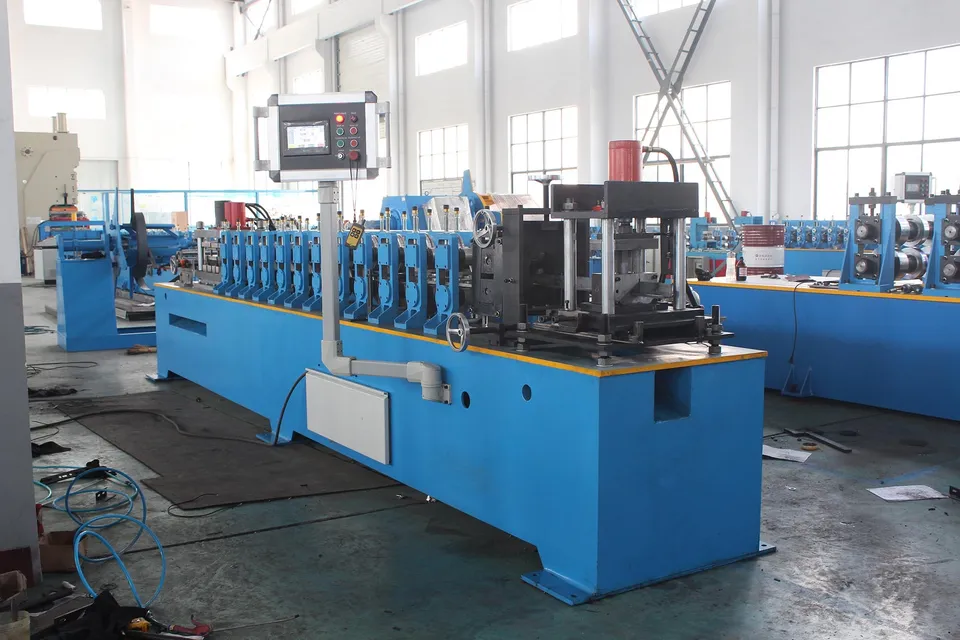
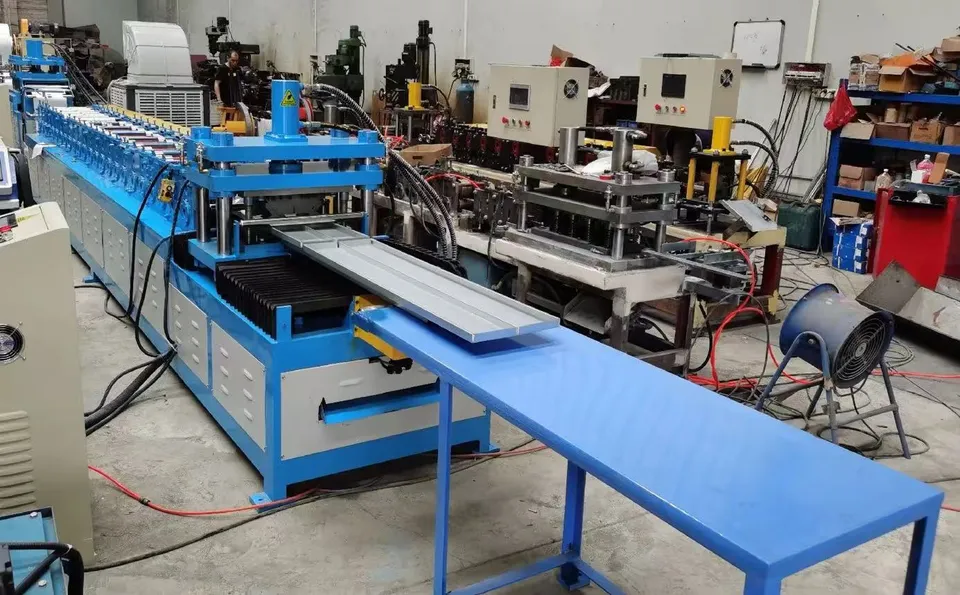
Workshop-zone views of multi-station roll forming lines and profile cutoff assemblies. Captions describe visible mechanical arrangements. They do not certify specific output or individual plant performance.
01Line layout and controls02Outfeed and sample handling
ELECTRICAL ADAPTATION
60Hz electrical engineering for Philippine industrial grids
Crucial differences between Chinese 50Hz equipment standards and Philippine 60Hz utility requirements.
Standard 60Hz across all Philippine transmission grids (NGCP / Meralco / Visayan Electric).
Standard 50Hz motors run roughly 20% faster when connected to 60Hz supplies. We configure drive gearing, pump displacements, and VFD parameters specifically for 60Hz operation to ensure designed line speeds and prevent motor overheating.
Site Supply Voltage
Varies by zone: 220V 3-phase 60Hz in commercial / municipal districts; 380V, 440V, or 480V 3-phase 60Hz in heavy industrial estates (PEZA zones).
Control transformers, motor winding selections, and contactor coils are matched directly to your documented site voltage. We verify whether the site supply is Delta (ungrounded or corner-grounded) or Wye (four-wire with neutral).
Motor Attestation
Safety and quality documentation for industrial drive motors.
Electric drive motors hold current CE attestation (Certificate M.2023.206.C82549, UDEM International) verifying compliance with EU Machinery Directive 2006/42/EC and EMC Directive 2014/30/EU.
Cabinet Enclosure & PLC
Tropical climate with high ambient humidity, salt air in coastal areas, and ambient temperatures.
Enclosed electrical cabinets with thermal management (cooling fans or optional cabinet heat exchangers), dust filtering, and English-language touchscreen PLC interfaces.
LOGISTICS & SUPPORT
Why Taibang for Philippine roll forming projects
Short maritime transit routes from North China to Manila and Cebu combined with practical tooling design review.
Direct sea freight: Cangzhou to Manila & Cebu
Our workshop in Cangzhou, Hebei, connects efficiently to Tianjin and Qingdao container ports. Container lines operate frequent direct sailings to the Port of Manila (Manila International Container Terminal - MICT and South Harbor), as well as direct or transshipment feeder services to the Port of Cebu, serving the Central Visayas region without transiting Luzon roads.
Sea-worthy container packing & bracing
Machinery shipments travel inside standard 40ft HQ shipping containers. Roll tooling and shafts receive protective anti-rust coatings and moisture-barrier film wrapping. Heavy machine chassis are anchored to container tie-down rings with structural steel wire ropes, turnbuckles, and timber blocking to prevent movement during sea transport.
Factory acceptance testing (FAT) records
Before any equipment leaves our workshop, the line is fully assembled, wired, and test-run with representative coil stock. We provide detailed multi-angle video recordings demonstrating profile geometry, cutoff operation, and PLC function. Clients are also welcome to visit our workshop or send an appointed inspection agent to observe trials in person.
Direct engineering dialogue
Every equipment inquiry is reviewed by technical engineers familiar with roll pass design, shearing mechanics, and regional steel specifications. We provide complete electrical schematics, hydraulic diagrams, foundation placement drawings, and consumable wear-parts lists in English.
TECHNICAL GUIDES & EQUIPMENT
Related equipment lines and technical articles
Explore complementary roll forming machinery and engineering resources for metal building products.
Continuous production lines for insulated EPS and polyurethane (PU/PIR) roof and wall panels used in cold-chain logistics, cleanrooms, and commercial structures.
Flexible steel framing lines producing C and Z purlins for pre-engineered buildings and industrial sheds, with stepless width changeover and multi-station hole punching.
Technical considerations for configuring Chinese roll forming equipment to 60Hz utility grids, motor frequency sizing, and electrical safety standards.
How to evaluate roll forming machine reliability based on frame construction, tooling pass counts, factory acceptance trials, and electrical engineering.