Rib-Type Metal Roofing Roll Forming Machine Guide for the Philippines
Technical evaluation and machine planning guide for Philippine roll formers and steel distributors manufacturing trapezoidal Rib-Type roofing panels. Outlines tooling design for trapezoidal ribs, anti-capillary side lap formation, 60Hz industrial electrical matching, and ocean freight to Manila or Cebu.
ENGINEERING NOTICE
Equipment configurations, tooling station counts, motor ratings, and line layouts are customized per project. All production parameters, profile tolerances, and delivery scopes are confirmed per signed project contract and agreed engineering drawings.
Examining typical profile characteristics and regional functional requirements for Rib-Type panels across commercial, agricultural, and industrial construction in the Philippines.
Trapezoidal Rib Stiffness
Rib-Type profiles feature raised trapezoidal crests that provide longitudinal beam stiffness across purlin spans. Tooling must form these crests uniformly to ensure consistent panel strength and prevent flattening under wind loads.
Anti-Capillary Siphon Flute Details
Under wind-driven tropical rainfall, moisture can be drawn between overlapping ribs by capillary action. Tooling designs often incorporate an anti-capillary break flute rolled into the under-lap rib to interrupt surface tension and guide trapped water down the slope.
Valley Drainage Capacity
Wide pans between main ribs facilitate the evacuation of heavy rainfall runoff. The roll tooling must ensure flat, ripple-free pans to avoid water pooling on shallow-slope installations.
MACHINE HIGHLIGHTS
Rib-Type Roll Forming Machine: Tooling Considerations
Mechanical design criteria and process considerations evaluated for this profile geometry.
Multi-Station Progressive Forming
Tooling passes shape the trapezoidal ribs progressively from center to outer edges, managing strip tension to prevent edge waves and maintaining dimensional consistency on prepainted coil stock.
Coil Surface Protection
Rollers undergo precision machining and protective plating to deliver smooth surfaces, preventing paint scuffing or coating transfer on pre-painted commercial coils.
Profiled Hydraulic Shear Cutoff
The cutoff mechanism uses profiled shear blades matching the specific rib geometry to produce clean, square cuts without deforming rib crests.
60Hz Industrial Electrical Integration
Drive motors, hydraulic pumps, and control systems are configured for 60Hz industrial electrical supply (220V, 380V, or 440V three-phase) suitable for Philippine manufacturing plants.
SPECIFICATION CHECKLIST
Technical Checklist: Inputs Required for Rib-Type Line Quotation
Before finalizing equipment dimensions and roll tooling schematics, our engineering team requires confirmation of the following specifications:
• Coil Feed Width & Edge DimensionsInput raw coil strip width and allowable edge slit tolerances from your coil supplier.
• Decimal Thickness Range (BMT & TCT)Confirmed metal thickness in decimal millimeters covering base metal thickness and coating/paint layers, rather than nominal trade terms.
• Steel Strength & Substrate GradeYield strength specifications (commercial mild steel or high-tensile grade) and coating type (galvanized or 55% aluminum-zinc alloy).
• Destination Electrical ParametersExact factory power supply specification: 220V 60Hz 3-phase, 380V 60Hz 3-phase, or 440V 60Hz 3-phase.
Note: All tooling designs are confirmed via CAD section drawing prior to workshop production.
Determined by rib geometry and forming pass simulation
Calculated to distribute deformation stress evenly across all rib crests and valleys.
Shaft Structure
Solid carbon steel shafts, precision turned and ground
Shaft sizing selected to prevent torsional deflection during continuous operation.
Roller Tooling
Machined carbon steel with protective surface plating
Surface hardness and finish specified to protect coil coatings from galling.
Cutting Mechanism
Hydraulic profile shear die matching panel cross section
Upper and lower dies matched to panel contour to ensure clean, burr-free cut edges.
Electrical & Drive System
60Hz industrial drive motors with PLC console
Configured for local grid frequency and voltage, featuring touch-screen batch length presets.
WORKSHOP VIEWS / PROJECT DISCUSSION
Look at the details. Define your requirements.
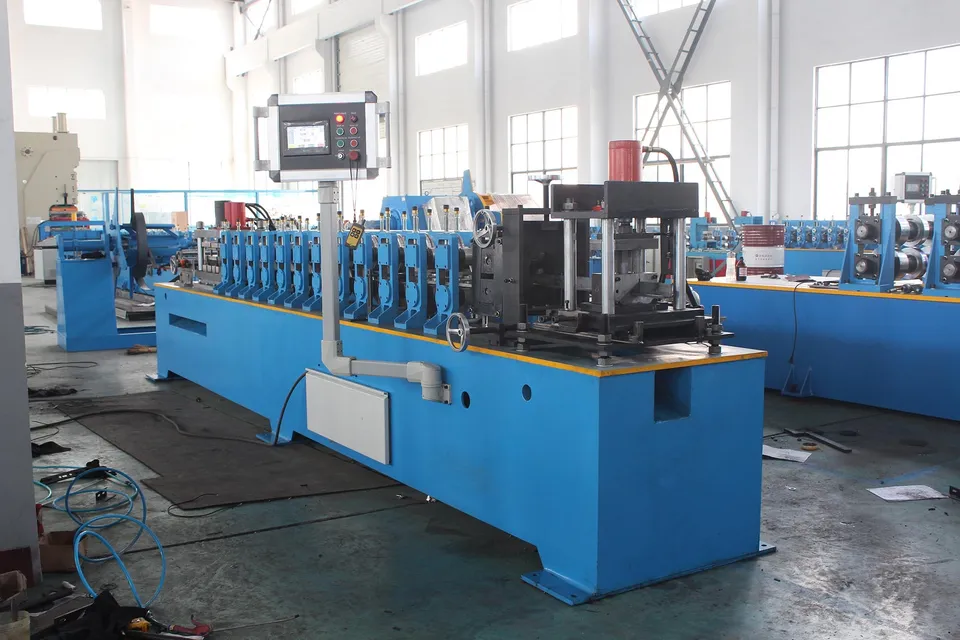
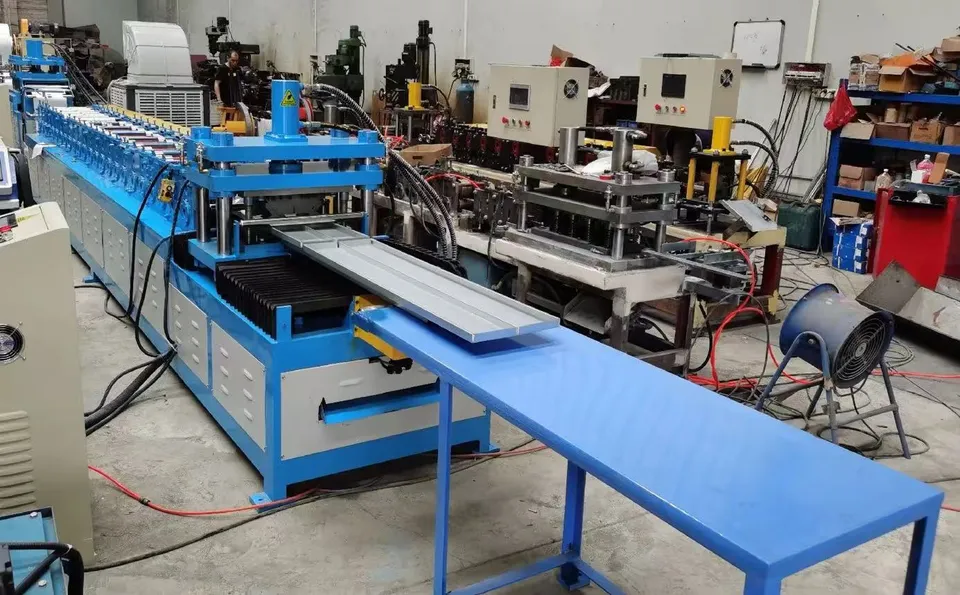
Workshop-zone views of multi-station roll forming lines and profile cutoff assemblies. Captions describe visible mechanical arrangements. They do not certify specific output or individual plant performance.
01Line layout and controls02Outfeed and sample handling
Technical clarifications on tooling design inputs, operating limits, and production feasibility.
How does Rib-Type differ from Longspan in the Philippine roofing market?
Rib-Type refers to the specific cross-sectional profile geometry (trapezoidal ribs with intermediate drainage valleys and overlap details). Longspan describes the operational practice of profiling sheets cut to full roof slope lengths to eliminate transverse end-laps. A Rib-Type cross-section can be produced as custom Longspan panels.
Why is an anti-capillary groove often specified on Rib-Type roofing?
Under high wind and heavy tropical rain, water can be drawn into the sheet lap joint through capillary tension. An anti-capillary groove provides a physical break in the contact surface, directing trapped moisture down into the drainage channel.
How are 60Hz power requirements handled for Philippine installations?
Drive motors, reduction gearboxes, and hydraulic pump assemblies are wound and rated specifically for 60Hz power at the confirmed factory line voltage (220V, 380V, or 440V three-phase) to ensure proper motor operating speed and thermal stability.
What container shipping routes are used for Philippine ports?
Equipment is packed and braced within standard ocean dry containers at our workshop and dispatched via Tianjin Port, with standard routing connecting to Port of Manila or Port of Cebu.
START ENGINEERING REVIEW
Initiate Technical Review for Your Philippine Rib-Type Line
Send your target profile CAD drawing, coil coating specifications, and plant electrical parameters. Our engineering desk will review tooling requirements and prepare an equipment proposal.